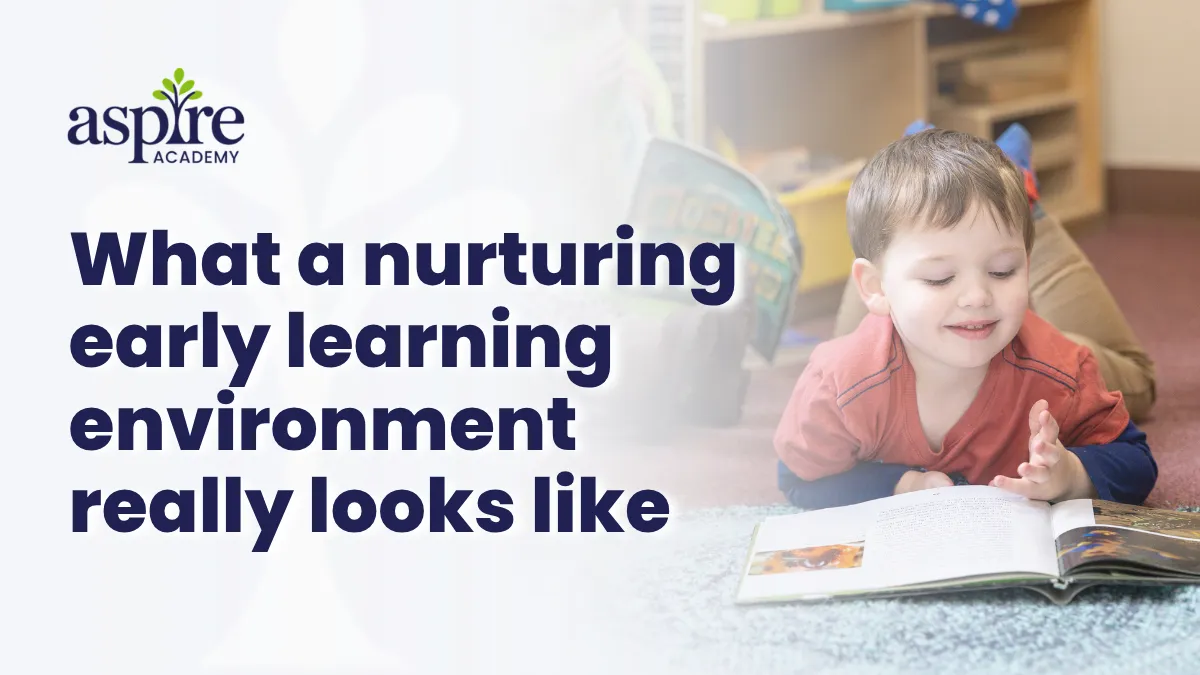
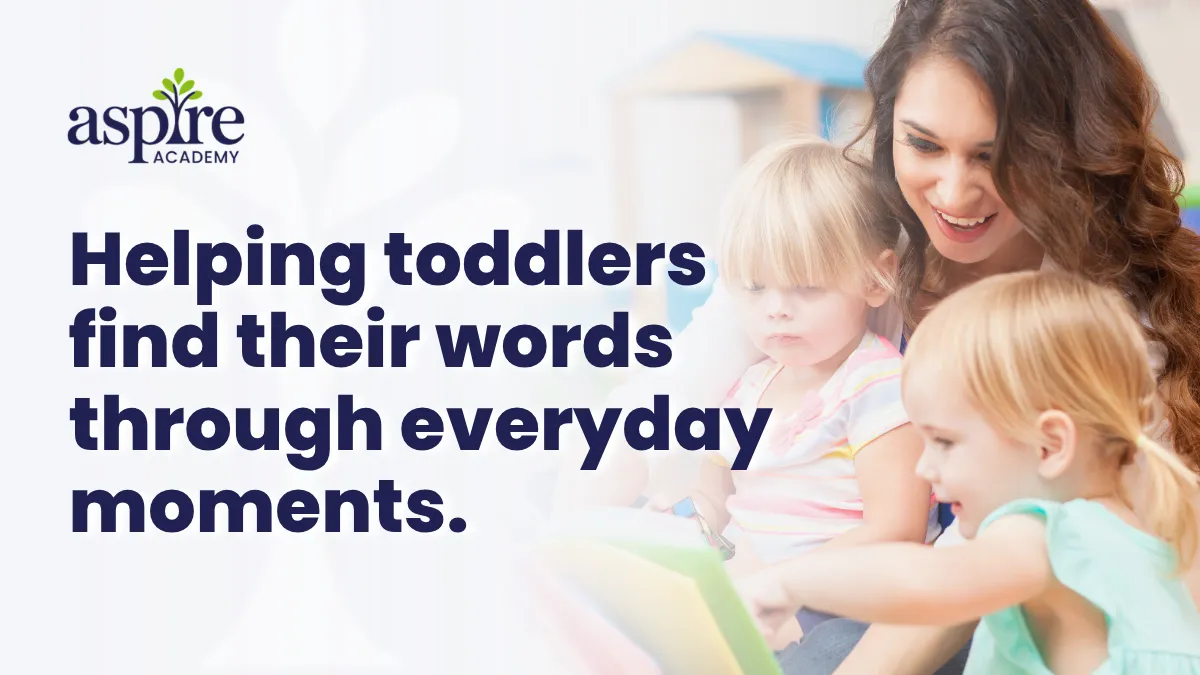
Listening to your toddler attempt to string their first words together is an incredible milestone. It is a season of “firsts” that marks a major shift in how your child interacts with the world. However, for many parents, it is also a time of quiet pressure. When you’re at a park in Waynedale or a playgroup in Fort Wayne, it’s hard not to compare. Is my child hitting their communication milestones? Will they be ready for preschool? Are they building the confidence they need to speak up?
When it’s time to transition into early education, you want to be certain the environment will nurture their growing vocabulary. Many parents researching local options wonder exactly how play based daycare improves toddler language development, especially when, to the casual observer, it looks like the children are “just having fun.”
For families in Fort Wayne, Waynedale, and the 46819 area, these questions often become part of the childcare search. Parents are not only looking for a safe place for their child during the day. They are looking for a place where their toddler will be spoken to, listened to, encouraged, and gently supported.
At Aspire Academy, we look at toddler care differently. We know that language development isn’t about flashcards; it’s about relationship-focused teaching. Our Waynedale toddler classrooms are intentionally built around three core values: Character, Confidence, and Curiosity.
For a two-year-old, curiosity invites new words, confidence gives them the courage to speak them, and character grows as they learn to use those words to share and show kindness. In our care, play is the curriculum. By looking closely at a typical day at Aspire Academy, you can see how everyday moments transform into major language milestones.
Why Toddler Language Grows Through Everyday Play
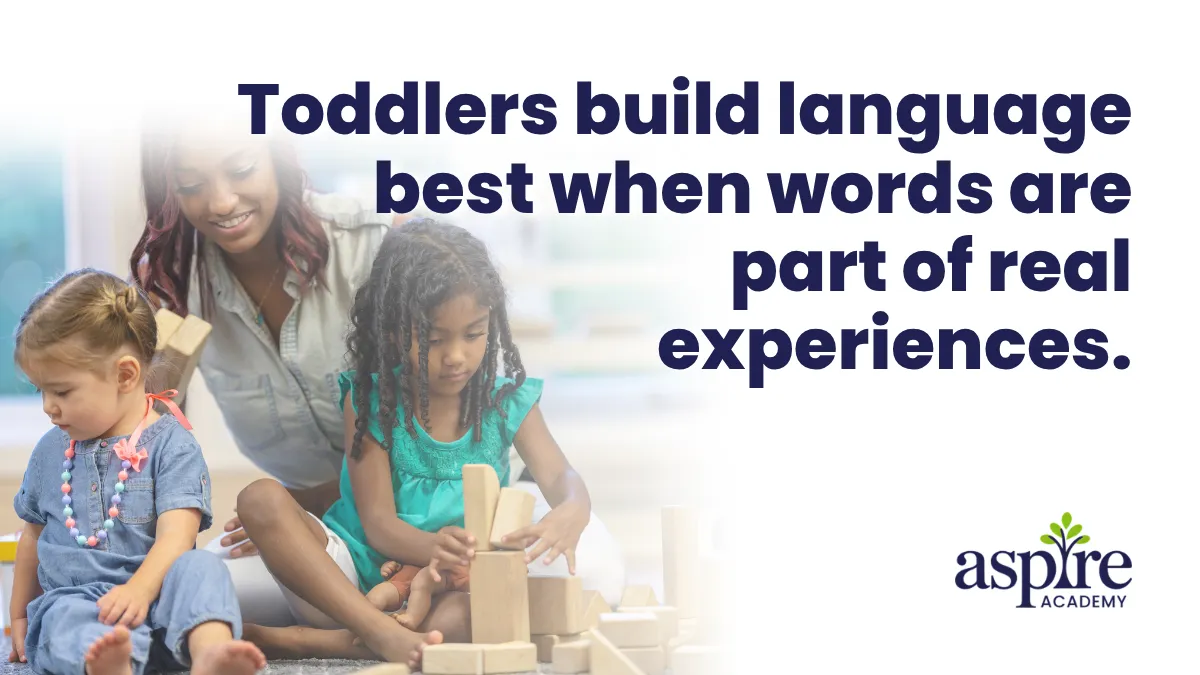
Adults often learn through direct instruction, reading, and structured practice. Toddlers, however, are wired differently. Their brains are designed to absorb information through active movement, emotional connection, and hands-on experiences. They don’t learn language by memorizing a list of words; they learn it by experiencing those words in action.
When a toddler builds a tower of blocks and watches it crash, they are not only practicing motor skills. If a caring teacher sits nearby and says, “The tall tower fell down. Should we build it up again?” the child hears words connected to something they just saw and felt. Words like “tall,” “down,” “build,” and “again” become easier to understand because they are tied to a real moment.
These back-and-forth interactions happen throughout a strong play-based daycare classroom. A child points to a bird, and a teacher responds, “Yes, that bird is flying.” A toddler reaches for more crackers, and a teacher says, “You want more crackers. Let’s ask for more.” These simple responses show children that their sounds, gestures, and words matter.
In a play-based setting, language is never forced; it flows naturally during moments of genuine interest.
How Play Based Daycare Improves Toddler Language Development
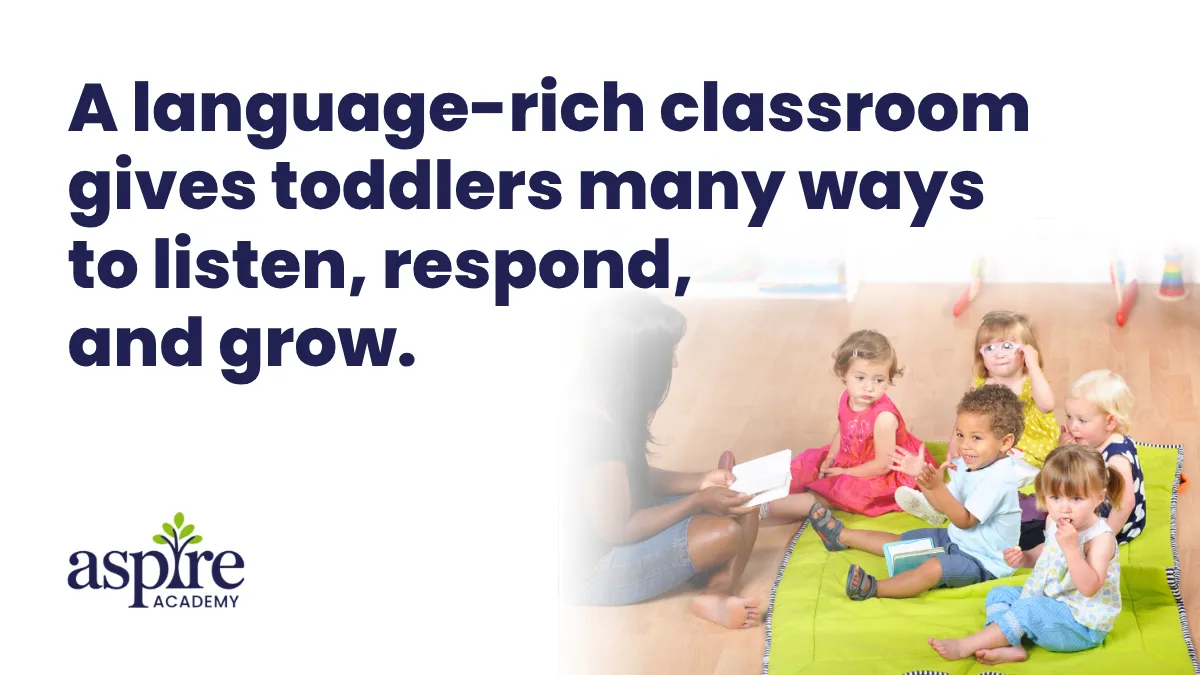
Understanding how play based daycare improves toddler language development requires a shift in how we view teaching. In a formal lesson, a child may be shown a picture and asked to repeat a word. In a play-based setting, that same word may appear naturally many times in meaningful situations.
For example, a toddler may hear the word “cup” while playing in a pretend kitchen, using a cup during snack, cleaning up cups after water play, and hearing a teacher say, “Your blue cup is on the table.” The word becomes familiar because it appears in real routines and experiences.
Words Are Connected to Real Experiences
Toddlers don’t memorize word lists; they absorb language by experiencing it. When an Aspire teacher sits at eye level during sensory play, words like squishy, chilly, or sticky suddenly make sense because the child’s hands are buried in play-do or water beads.
Children Learn Through Imitation
Toddlers are natural mimics. They copy sounds, gestures, facial expressions, and words from the people around them. Hearing a classmate say “my turn” or “more please” provides real-world context that a textbook or tablet simply can’t replicate. It teaches them how language works as a social tool.
Emotional Security Encourages Expression
A toddler’s ability to communicate is closely tied to how safe and understood they feel. Children are more likely to try new words when they know a trusted adult will respond warmly, even if the word is not perfect.
A warm play-based environment gives toddlers room to try, pause, gesture, babble, repeat, and try again. This matters because confidence often comes before clear expression. When toddlers feel that their voice matters, they are more willing to use it.
What a Language Rich Daycare Environment in Waynedale Should Include
For parents searching for a language-rich daycare environment in Waynedale or the surrounding Fort Wayne area, it helps to picture what a supportive classroom actually looks and sounds like. It goes far beyond simply having a bookshelf or colorful posters.
A truly language-rich classroom is highly interactive. You will notice that:
- Teachers talk with children, not at them: Even if a toddler can only point, a skilled educator responds as if the child has spoken a full sentence. This validates the attempt and encourages the “rhythm” of conversation.
- Narration is constant: Teachers put words to feelings and actions throughout the day. “You look frustrated because that puzzle piece won’t fit. Let’s try turning it!” This gives the toddler the exact vocabulary they need for their current emotional state.
- The environment invites discovery: Materials are placed at eye level to encourage children to point, ask, and share discoveries.
- Predictable routines are established: Routine provides a framework where language happens the same way every day. Washing hands, sitting for a snack, and putting on coats all come with a specific set of repeated words, helping toddlers anticipate and eventually use those words themselves.
Toddler Speech Development Daycare Activities That Feel Natural
The most effective toddler speech development daycare activities rarely look like formal lessons. Instead, they are woven into the day. Strong preschool programs for 2 year olds use simple, meaningful activities to encourage communication in ways that feel natural and enjoyable.
Books and Interactive Storytelling
Books introduce toddlers to new words, sounds, emotions, characters, and story patterns. At Aspire Academy, we don’t just read at the children. Our teachers pause, use animated expressions, and ask, “Oh look, where is the puppy hiding?” A toddler points, another babbles, and a third tries out the word “Box!” By treating every book as a two-way conversation, we validate their early communication attempts and make reading an active, joyful group experience.
Songs, Music, and Rhythm
Singing can be a very helpful tool for toddler language development. Songs naturally slow down the pace of speech, emphasizing syllables and rhymes. Action songs (like “The Itsy Bitsy Spider”) require children to connect auditory instructions with physical movement, which strengthens the brain’s processing power. They may clap, stomp, wave, copy hand motions, or make familiar sounds.
Music also supports listening and memory. Familiar songs help toddlers know what comes next, which can make them feel confident enough to join in.
Open-Ended Sensory Play
When toddlers explore sand, water, or sensory bins, they experience new sensations. This is the perfect time for teachers to introduce descriptive adjectives: squishy, slimy, heavy, gritty, cold. Because the child is focused on the sensory input, the descriptive words attach easily to their memory.
Imaginative and Pretend Play
A play kitchen or a bin of dress-up clothes is a language goldmine. Pretend play requires children to use words to explain what they are doing. A toddler handing a teacher a plastic cup might hear, “Thank you for the hot tea! It is very delicious.” This models conversational turn-taking and introduces the concept of using language to share ideas that are not literally in front of them.
Daily Routines and Transitions
Routines are some of the most overlooked language-building moments in daycare. Washing hands, cleaning up, preparing for snacks, going outside, and getting ready for rest time all involve repeated words and actions. Because routines happen every day, toddlers begin to understand the language connected to them. A teacher may say, “First, we wash our hands, then we eat a snack,” or “Your coat goes on before we go outside.” These repeated phrases help toddlers understand sequence, expectations, and independence.
From Toddler Words to Play Based Preschool Language Skills
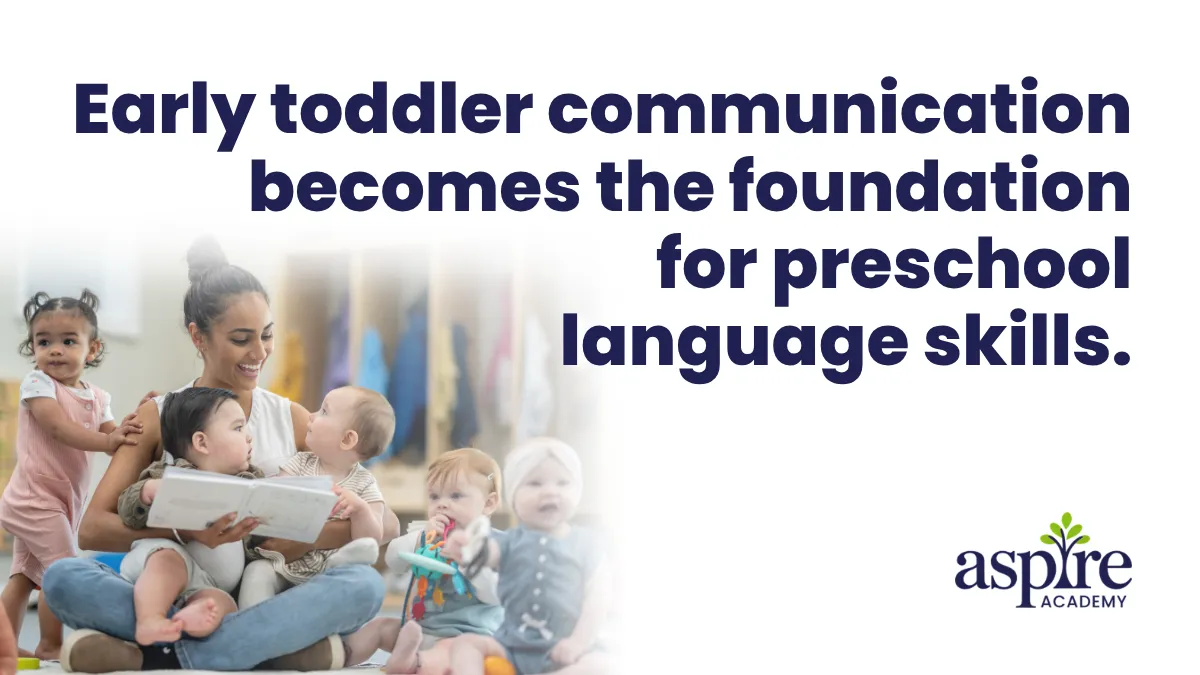
The communication practice a child gets in a toddler classroom sets the stage for everything that comes next. The jump from toddlerhood to preschool is significant, and the language foundation built during these early years can make that transition smoother.
As children move toward play based preschool language skills, the focus shifts from naming objects to complex social interactions. In preschool, children use language to:
- Negotiate roles in a game (“I’ll be the doctor and you be the patient”).
- Tell imaginative stories with a beginning, middle, and end.
- Ask “why” and “how” questions to understand the world.
- Begin recognizing the sounds of early literacy (phonemic awareness).
A toddler who has spent time in a supportive, play-based daycare enters preschool with the confidence to speak up in a group and the listening skills required to follow multi-step directions. They understand that their voice matters.
This is why play-based learning should not be seen as less educational than formal instruction. For toddlers, purposeful play can be a developmentally appropriate way to build communication, confidence, social understanding, and early learning skills.
What Parents Can Look for During a Toddler Daycare Tour in Fort Wayne
When you tour a potential daycare, look beyond the equipment. Pay attention to the “audio” of the room. A toddler classroom does not need to be silent to be focused. A room filled with songs, conversation, questions, laughter, and guided play can be a strong sign that language is being used naturally throughout the day.
Here is a checklist of what to observe:
- Are teachers getting down to the child’s eye level during play and conversation?
- Do you hear “back-and-forth” exchanges? Or do you only hear teachers giving commands?
- Are there cozy areas for reading? A dedicated space for books shows that literacy is valued.
- How are conflicts handled? Do teachers use words to help children express their feelings?
- Is there a variety of open-ended toys? Items like blocks and “loose parts” encourage more conversation than electronic toys that talk at the child.
- Do the children seem engaged? A quiet room isn’t always a learning room; a room filled with the “hum” of play is usually where the most language development is happening.
Parents should also remember that toddlers develop at different rates. Some children use many words early, while others take more time. A daycare can support communication development, but it should not diagnose or treat speech delays.
If a parent has concerns about hearing, speech delays, regression, or missed developmental milestones, they should speak with their child’s pediatrician or a qualified speech-language professional.
Supporting Toddler Language Development at Aspire Academy
At Aspire Academy, we believe that children grow best when they feel secure, capable, and inspired. Located in the Waynedale community of Fort Wayne, our toddler program is intentionally designed to support rapid physical, emotional, and language development without ever rushing your child’s natural pace.
Our approach is rooted in three core values: Character, Confidence, and Curiosity.
- Curiosity invites new words as children explore our sensory bins and art materials.
- Confidence gives a child the courage to speak those words, knowing they will be heard and valued.
- Character grows as they learn to use their words to interact with kindness and respect alongside their peers.
In our toddler classrooms, language development happens through meaningful daily experiences. Children engage with open-ended play, art materials, sensory tools, music, movement, rhythm activities, simple puzzles, books, pretend play, conversations, and songs. These activities give toddlers natural opportunities to listen, respond, make choices, express needs, and interact with others.
Your child’s early learning years matter, and choosing the right environment can help you feel confident about their daily care and development. Come see the Aspire Academy difference for yourself. Listen to the hum of our classrooms, meet our dedicated teachers, and see where your child’s character, confidence, and curiosity will flourish.
Schedule your tour today and take the first step toward finding a nurturing, play-based toddler program in Fort Wayne where your child can feel supported, understood, and encouraged to grow.
Frequently Asked Questions
Can play-based daycare in Fort Wayne help my toddler talk more?
Play-based daycare can support toddler communication by providing children with daily opportunities to listen, respond, imitate, and practice words in real experiences. Through songs, books, pretend play, routines, and peer interaction, toddlers begin connecting language to actions, feelings, and familiar moments.
What activities support toddler speech development in daycare?
Helpful activities include interactive story time, fingerplays, action songs, sensory exploration, pretend play, teacher narration, and daily routines. These activities give toddlers repeated chances to hear words, connect them to movement or objects, and practice communication in a natural setting.
What should parents look for in childcare in Fort Wayne, IN?
When comparing childcare in Fort Wayne, IN, look for teachers who speak warmly with toddlers, get down to the child’s level, respond to gestures and early words, and name feelings and actions throughout the day. A language-rich classroom should feel calm, engaged, and responsive.
How can a preschool in Waynedale build on toddler language skills?
A preschool in Waynedale can build on toddler language skills by helping children use words for more complex communication. As children grow, they begin asking questions, telling simple stories, following directions, joining group activities, and using language to interact with classmates.
What should I look for when searching for a daycare near me in Fort Wayne?
When visiting a daycare near me in Fort Wayne, listen for warm conversations, songs, questions, and guided play. Look for teachers who respond to a child’s babbles, gestures, and early words as meaningful communication.
How do I choose the best toddler care in Fort Wayne?
The best daycare in Fort Wayne for your family should feel safe, nurturing, and developmentally appropriate. Look for a program that encourages communication without pressure, supports social interaction, and uses purposeful play to help children build confidence, independence, and early language skills.
Can childcare in 46819 help if I am concerned about my toddler’s speech?
Childcare in 46819 can support communication development through daily routines, play, songs, books, and teacher interaction. However, daycare should not diagnose or treat speech delays. If you have concerns about hearing, regression, or missed milestones, speak with your child’s pediatrician or a qualified speech-language professional.
Contact Aspire Academy today to schedule a tour and discover a place where your child’s character, confidence, and curiosity can truly flourish.